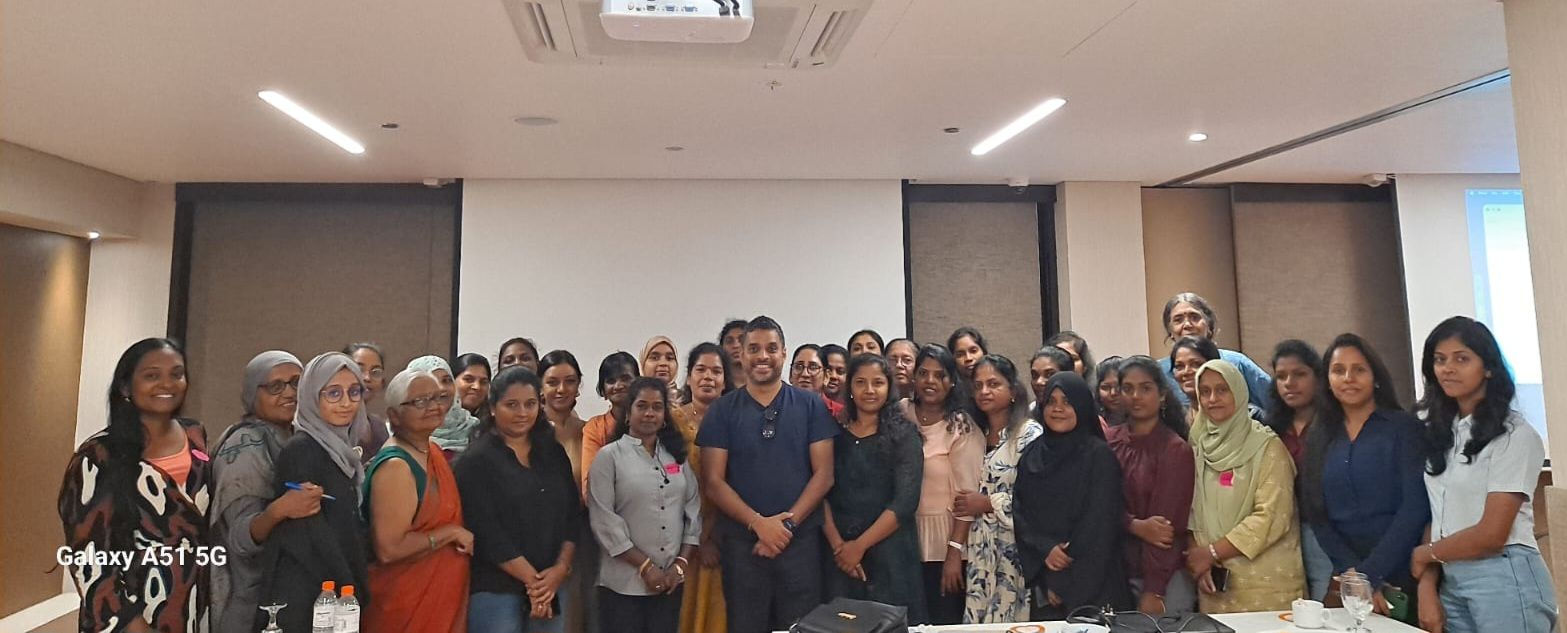
Successfully Concluded Groundbreaking AI Training Programme for Women in Media
The South Asian Women in Media – Sri Lanka (SAWM-SL) successfully concluded a pioneering series of artificial intelligence (AI) training workshops for women journalists and media professionals, marking a significant milestone in strengthening digital capacity and safety within Sri Lanka’s media landscape.
Held in November last year, the trilingual programme, conducted in English, Sinhala and Tamil, combined in-person workshops in Colombo with structured online follow-up sessions, bringing together 96 journalists from all nine provinces, including the North and East, helping enhance participants’ understanding of generative AI technologies, ethical newsroom adoption and practical responses to technology-facilitated gender-based violence.
Initial calls generated over 150 applications from across the country, underscoring both the urgency and demand for AI-focused training tailored specifically to women in media.
Titled ‘Enhancing Understanding and Knowledge of AI Among Women in the Media’, the initiative was implemented by SAWM-SL with the support of the Embassy of the Netherlands in Sri Lanka under its human rights portfolio. It is widely regarded as the first programme of its kind in Sri Lanka: targeted, custom-designed and AI-focused, with a dual emphasis on harnessing AI’s potential while safeguarding against its risks.
Speaking at the opening session of the first workshop held on November 4 at the Mandarina Hotel in Colombo, Iwan Rutjens, Deputy Ambassador of the Netherlands to Sri Lanka and the Maldives, highlighted the dual reality artificial intelligence reshaping journalism at an unprecedented pace and the emerging threats, especially deepfakes, coordinated disinformation campaigns and technology-facilitated gender-based violence (TFGBV) that present new and complex challenges.
In her welcome address, SAWM-SL Trustee Sharmini Boyle described the programme as a landmark initiative in the organisation’s 16-year history of advancing women in media, noting that the workshops addressed a rapidly evolving and critically important field, with the goal of equipping women journalists with the knowledge and tools needed to navigate AI-driven transformations in the industry.
The in-person workshops were conducted as three separate full-day sessions to ensure linguistic inclusivity: English-language media on November 4, Sinhala-language journalists on November 6, and Tamil-language participants on November 11. This was followed by online sessions on November 18, 20 and 25 respectively, enabling continued engagement, deeper discussion and peer exchange.
The programme was designed and delivered by Dr Sanjana Hattotuwa, an internationally recognised specialist, who provided participants with both conceptual grounding and hands-on experience.
The curriculum was structured around equipping participants with critical dual capabilities: leveraging AI responsibly to enhance reporting, while developing robust defences against its misuse.
Certificates of participation were awarded to all trainees in recognition of their successful completion of the programme.